
Empty both chambers
Leftover solution from last night is not a head start. Pour it out before the case goes anywhere near the sink.
Reach the team
Jl. Kemang Raya No. 27, Bangka, Mampang Prapatan, Jakarta Selatan, DKI Jakarta 12730, Indonesia
Hours
Monday to Friday, 9:00 AM – 6:00 PM
Saturday, 9:00 AM – 1:00 PM
Most of the routine that keeps reusable soft lenses safe happens in about ninety seconds at the bathroom sink. Wash and dry your hands, use fresh solution, keep the case clean, and keep water away from the lens. That is most of it. This guide covers the sequence and the reasons behind each step, including the mistakes that look harmless.
Walk through the routineWash your hands with soap and water, then dry them with a clean towel before touching a lens or your eye. Wet hands are a problem because tap water carries organisms that do not belong on a lens, and the drying step is the part people skip most often.
Avoid oily or heavily scented soaps, since residue transfers easily to the lens surface and can leave a film that feels like discomfort. If you handle lenses away from a sink, carry a small bottle of hand sanitizer and let it dry fully before the lens touches your finger.
Soap and running water remove oil and surface grit before your fingers go anywhere near the lens.
A clean towel, not a shared hand towel. Damp fingers carry the same water you just rinsed off.
Oily, scented, or exfoliating soaps leave residue that transfers straight onto the lens surface.
Hand sanitizer works if you let it dry completely. Wet sanitizer on the fingertip is still water.
Contact lens solution is used to rinse, clean, and disinfect reusable lenses, and it is designed for single use in the case. Topping up the old solution dilutes the disinfectant and leaves the case environment weaker than intended, which is why the bottle instructions treat each fill as a fresh measure rather than a top-up.
The correct sequence is short: empty the case, rinse it with fresh solution, and refill it. Never use tap water as a substitute for solution, and never use saliva, which is a common reflex when a lens feels dry. Saliva is not sterile, and the lens goes straight back onto your eye.
One more habit worth holding line on: keep the bottle tip off the sink and off your fingers. Touching the nozzle transfers whatever is on your hands into the bottle, and the bottle then stays in rotation for weeks.
Lenses go in, case is emptied
Leaving old solution sitting in the case all day gives it nothing to do and everything to grow in.
Fresh fill, fresh caps
Rinse the chambers with new solution, then refill. Both sides, every night.
Water, saliva, or a top-up
Three shortcuts that undo the rest of a good routine in one move.
Multipurpose solutions are common for soft lenses and cover rinsing, cleaning, and disinfection in one product, which is why they fill most of the shelf. Follow the instructions on the bottle rather than improvising, and check the label against your lens type before you buy a replacement. Some wearers with sensitive eyes do better on a different product, and that is a conversation for your eye-care professional rather than a guess at the pharmacy.
Do not mix solution brands in one case. Two products made for the same job can still behave differently together, and once they are mixed you no longer know what your lens is sitting in.
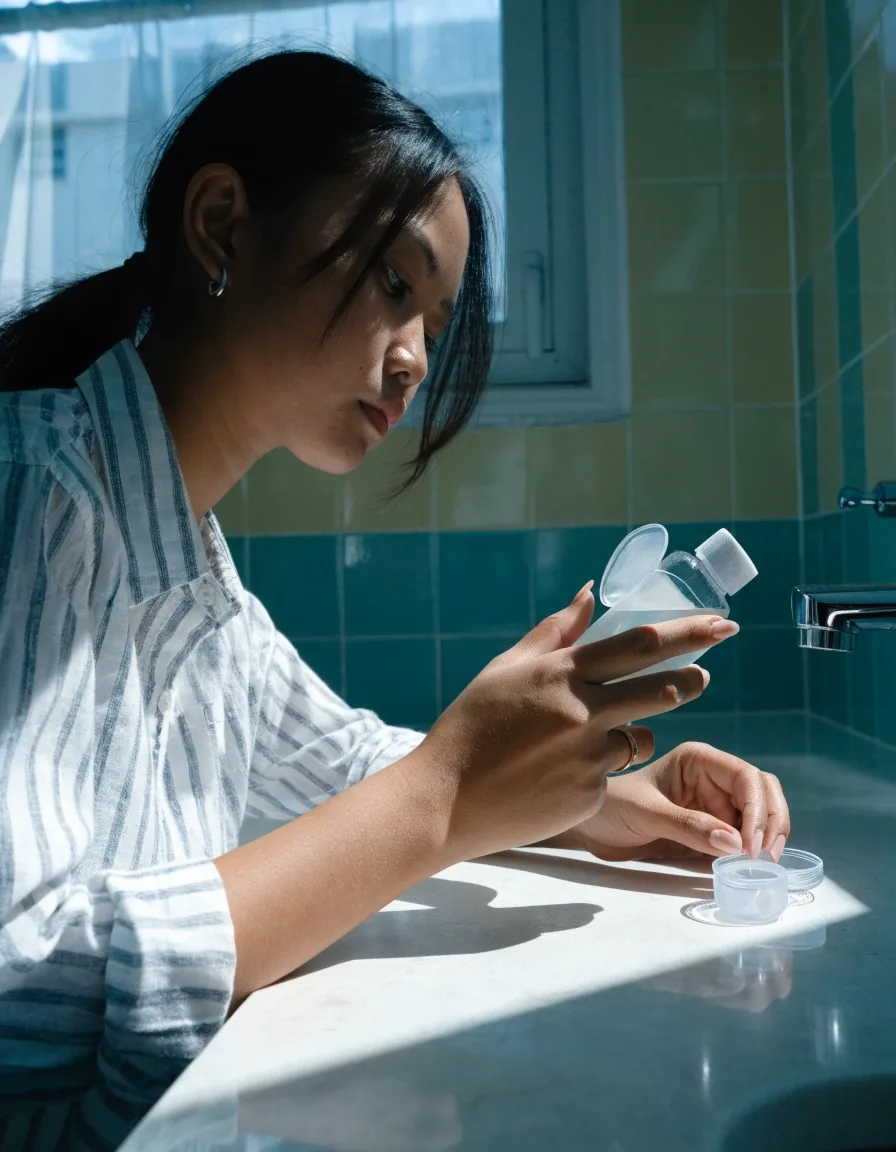
One bottle, one lens type, one routine. Keeping the product consistent makes it easier to notice when something changes.
The case sits in a warm, wet environment, which is exactly what microbes like. Empty it after every use, rinse it with fresh solution, and let it air-dry upside down with the caps off. Replace the case regularly rather than waiting for it to look worn, because the wear you can see is not the whole story. Lens case hygiene is the least glamorous part of lens care and one of the most common places where a good routine quietly breaks down.
Empty both chambers
Leftover solution from last night is not a head start. Pour it out before the case goes anywhere near the sink.
Fresh solution only
Use the bottle, never the tap. Rinsing the case in water defeats the point of everything that goes into it.
Upside down, caps off
Draining the case keeps the chambers dry between uses, which is the part a damp closed case cannot do.
On a regular schedule
Swap the case on a repeating schedule you can remember rather than when it finally looks tired.
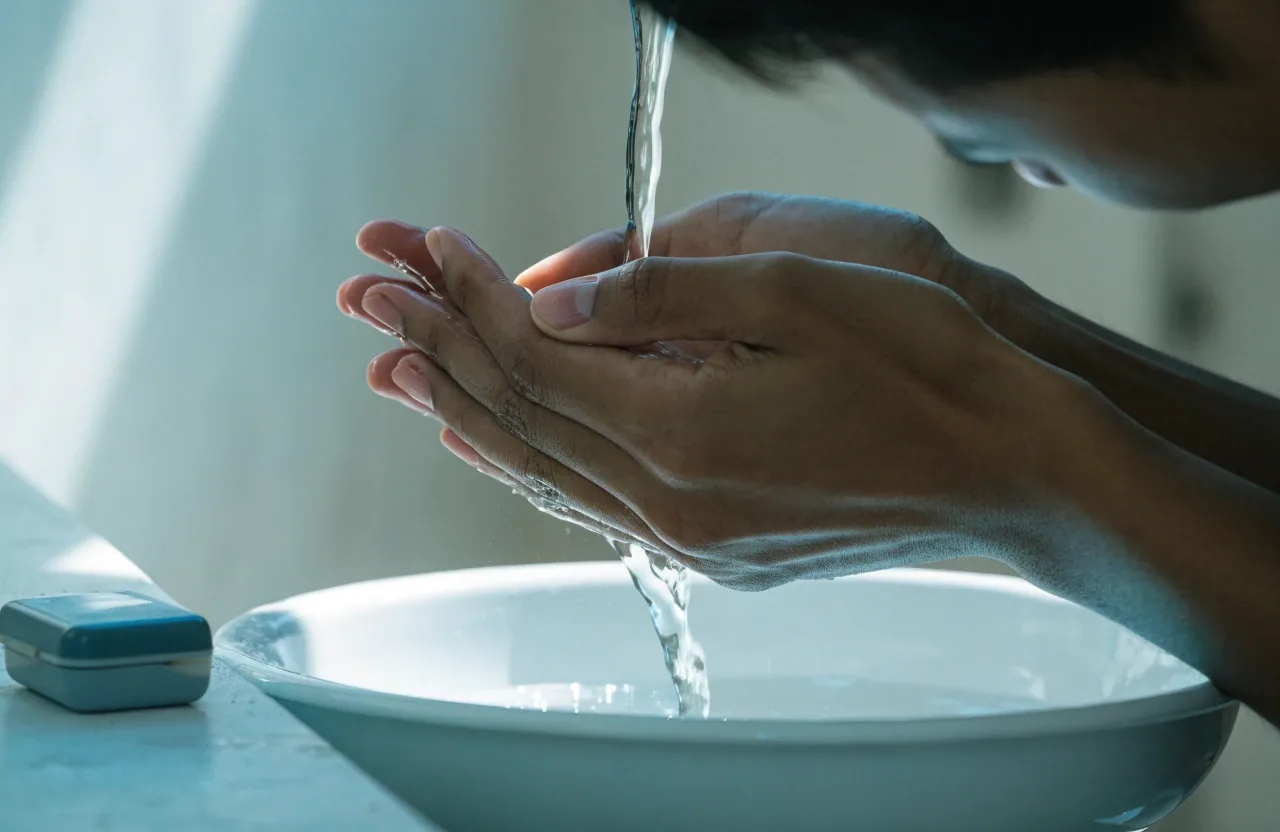
Tap water, bottled water, and pool water all carry organisms that can attach to a lens and stay against the eye. That is why lenses should not be rinsed or stored in water, and why swimming and showering with lenses in needs explicit approval from your eye-care professional rather than a judgement call at the poolside.
The same rule applies to lens cases: they get solution, not water. A case rinsed under the tap and left to dry still holds a film of whatever came out of the tap, and the lens then sits in it overnight.
Never rinse a lens under the tap to clear a speck of dust.
Ask before swimming or showering with lenses in, and follow the answer.
Keep the case away from the basin rim where splash lands.
Reusable lenses go into a clean case filled with fresh solution and stay there until you wear them again. Close the caps properly, and keep the case off the bathroom counter where dust and aerosols settle. A shelf inside a cupboard is a better home than the rim of the sink.
If you will not wear the lenses for a while, follow the storage guidance that came with your solution rather than guessing. Storing lenses dry, or in water, is never right for soft lenses, and a lens left to dry out can lose the shape and surface it needs to sit comfortably.
When you open the case again, look at the lens before it goes in your eye. If it is torn, cloudy, or stuck to the chamber wall, that lens is done.
Heat and humidity are part of daily life in Indonesia, and they change how you pack. Keep solution out of direct sun in a bag, check expiry dates before you leave, and carry it in a sealed bag inside your carry-on rather than in checked luggage where it can be crushed or lost.
Pack enough for the whole trip plus a margin. If you run out, do not substitute water or another product as a stopgap, and do not borrow solution from another wearer.
Enough solution and a spare case, plus a small margin for delays. Running out mid-trip is the moment shortcuts get tempting.
A closed bag in a hot car is not a good place for solution. Store it somewhere shaded and stable.
Before the flight, not at the hotel sink. Expired solution belongs in the bin, not in the case.
Daily disposables sidestep the whole problem, which is one reason they are popular for short trips: no case, no solution, no storage.
If the daily routine keeps slipping, that is useful information rather than a personal failing. Some wearers do better switching to daily disposables, which removes cleaning and storage entirely. Others simplify by keeping everything in one place, so the case and the bottle are never more than an arm's length apart. The right fix depends on which step keeps getting missed, and that is worth naming honestly at your next follow-up exam.
Missing step, different fix
Short answers to the three points that come up most often when a routine starts to fray at the edges.
No. Tap water carries organisms that can attach to the lens and stay against the eye. Use fresh contact lens solution, or use daily disposables that need no rinsing at all.
Replace it regularly rather than waiting for visible wear, since the case stays warm and wet between uses. Empty it, rinse it with fresh solution, and air-dry it after every use.
Yes. Solution is designed for single use in the case. Topping up old solution weakens disinfection, so empty the case and refill with fresh solution each time.
This page covers the sink-side routine. The related guides below pick up the parts that sit around it: how often a lens should be replaced, how comfort and overnight wear behave, and what a follow-up exam checks. Questions about the content itself are welcome by email during working hours.
Bright Focus Way · Jl. Kemang Raya No. 27, Bangka, Mampang Prapatan, Jakarta Selatan, DKI Jakarta 12730, Indonesia
Monday to Friday, 9:00 AM – 6:00 PM · Saturday, 9:00 AM – 1:00 PM
Our editorial desk sits at Jl. Kemang Raya No. 27 in Mampang Prapatan. If you would rather ask a hygiene question in person than by email, this is where we are, Monday to Saturday.